JEE Revision Strategy: How to Revise the Complete Syllabus
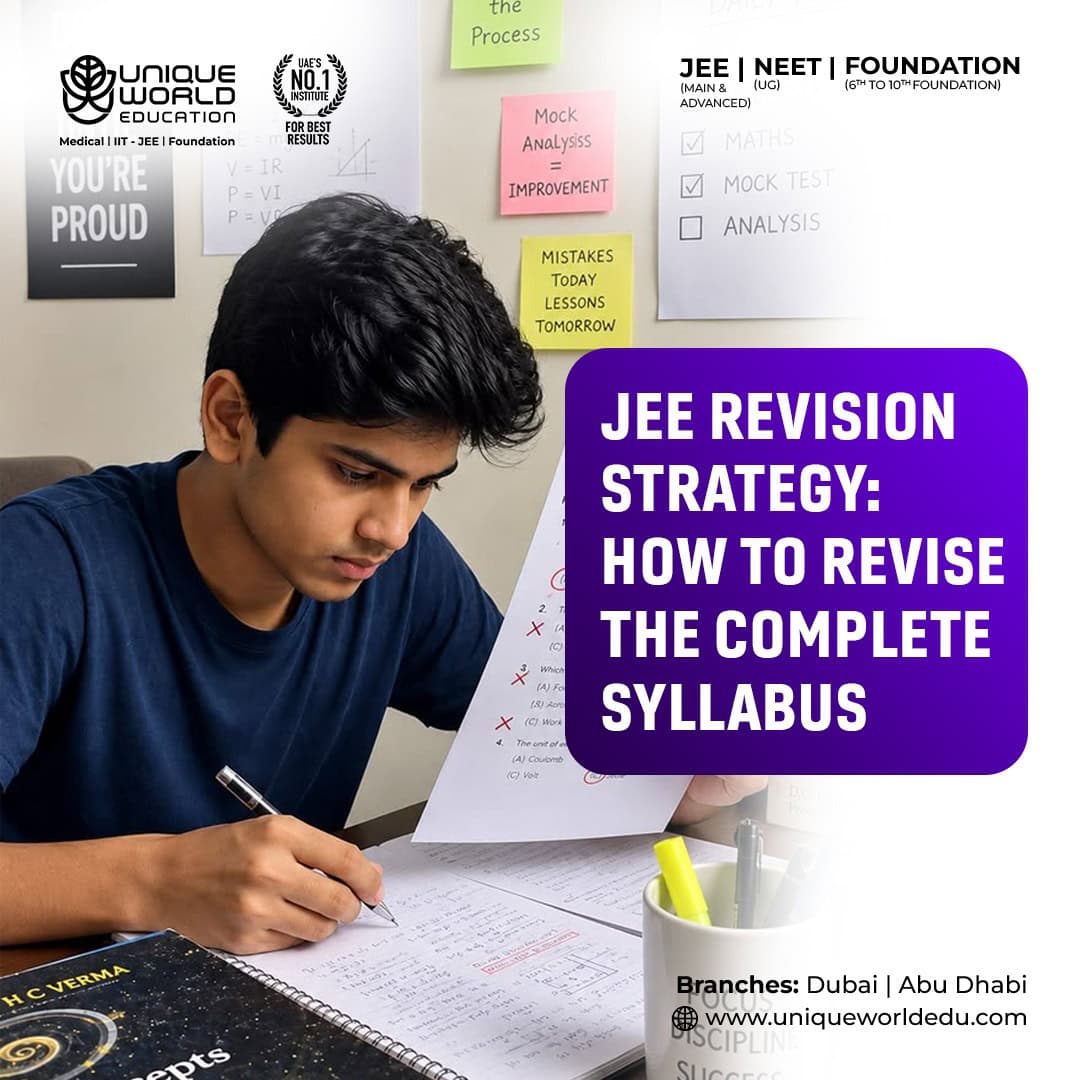
Preparing for Joint Entrance Examination (JEE) is perhaps one of the most intellectually satisfying but difficult paths that an engineering student can embark upon. The syllabus comprises an ocean of theoretical concepts, complicated formulas, and problem solving techniques that are a part of Physics, Chemistry, and Mathematics. As the exam date approaches, it becomes all too apparent how much one needs to revise.
But success in JEE isn’t necessarily based on revision amount; it is actually the quality of revision that will make all the difference. A smart, well-conceived revision technique will allow the test taker to go beyond knowing something and applying it during an exam. For whether you have aspirations to ace JEE Main or JEE Advanced, the art of revision is the final piece of puzzle.
1. Identify and Categorize the Syllabus
In working out an extensive revision strategy for yourself, one needs to recognize that not all chapters are equally important and equally demanding. Jumping onto your textbooks straightaway without thinking may lead to a sheer waste of your precious time.
- Chapter Importance Analysis: Go through the past year question papers and find those high scoring chapters which come up year after year. Give more emphasis to your core chapters, but don’t let your other chapters be lagging behind.
- Assessment of Your Performance: Categorize your syllabus into three categories; first one being the mastered chapters, second chapter being understood chapters but in which you tend to make silly mistakes and thirdly being the weak chapters which make you nervous.
- Time Management: Spend most of your revision time in improving your moderate and weak zones and keep revising the strong zones through problem-solving.
Students pursuing any formal course of study will find it immensely beneficial to get themselves enrolled in IIT JEE coaching classes dubai where the faculty helps you divide your syllabus into priority areas.
2. Consolide your study material and short notes
In the course of the initial studying process, you might have referred to several books, lecture notes, and assignment papers. While revising, trying to refer to too many sources would just confuse you.
- Use Concise Notes: The most important thing is to use your classroom notes, formula sheet, and short notes prepared in Class 11 & 12.
- Flashcard of Formulas: Mathematics & Physics are all about formulae, whereas chemistry, more specifically inorganic chemistry, depends on periodic trends, reactions, and name reactions. It would be better to maintain flashcards of formulas and name reactions.
- Refer to Core Concepts: It’s better to focus on derivations, core definitions and problem models than going through theoretical concepts in detail.
Students who are preparing both for competitive exams and schooling, simultaneously, get a better understanding of the concept by joining specialized CBSE Tuition Classes in Dubai.
3. Strike the Right Balance Between the Three Core Subjects
It is vital to strike a right balance between Physics, Chemistry, and Mathematics while preparing for the JEE exam, and this can be done only with proper planning in line with the requirements of each subject:
- Chemistry: You have to give equal weightage to Physical Chemistry, Organic Chemistry, and Inorganic Chemistry. Inorganic Chemistry involves constant reading of NCERT books. Organic Chemistry should include understanding the mechanism of reactions and reactions instead of just learning their names. Physical Chemistry involves constant numericals.
- Physics: Conceptual understanding is required in Mechanics, Electrodynamics, and Modern Physics. Solving problems will help you understand the interrelation between concepts in one question.
- Mathematics: Mathematics requires practice through pen and paper. Reading solved examples is not sufficient. You have to revise Calculus, Algebra, and Coordinate Geometry through problem sets.
4. Practicing Using Mock Test Papers and Timed Examinations
Practice without testing is insufficient for effective revision. There is a significant difference between knowing a certain concept theoretically and implementing the same successfully in a period of exactly three hours.
- Practice Testing Environment: Try practicing with complete mock test papers in an environment similar to the examination hall. Switch off any form of distraction, time yourself, and learn how to move on from questions which you might find tough to solve.
- Review Errors: The most important phase of a mock test is the analysis of errors made in the same. Keep a log of the conceptual errors or any other mistakes you may be making and revise those.
- Stamina: Testing oneself rigorously will help develop the necessary stamina to maintain efficiency throughout the exam period.
Prepare for IIT JEE like never before with the help of Unique World Education
Preparing yourself for the extensive range of IIT JEE requires effort, but you are not alone in this task. Through the services of Unique World Education, we provide the budding engineers with complete syllabus preparation, best quality Indian faculty, mentoring facilities, and performance tracking mock tests to ensure you get the best marks. Whether it is structured guidance or the best JEE Coaching in Dubai that you are searching for, our programs are specially designed for your success. Contact us at Unique World Education today!